 plasma.to
Plasma.to connects stablecoin payments and DeFi on the same network
Updated
Plasma.to connects stablecoin payments and decentralized finance (DeFi) through an Ethereum-compatible Layer 1 blockchain. PlasmaBFT handles consensus, Reth executes smart contracts, and XPL pays ordinary transaction gas. Eligible USD₮ transfers can use sponsored routes, while lending and exchange applications share the network's execution environment. Plasma One adds a stablecoin account and Visa card above that infrastructure. These components support different tasks, with separate conditions for transfer sponsorship, financial applications, and access to payment services.
Bottom line: A sponsored stablecoin transfer can avoid user-paid gas without making DeFi interactions or bank withdrawals free of other charges.
Are all transactions on Plasma free?
Not all Plasma transactions are free; eligible USD₮ transfers through supported sponsored routes can avoid user-paid network gas. Ordinary contract interactions incur gas, and direct browser-wallet transactions ordinarily require XPL. The transfer method determines access to sponsorship, alongside eligibility checks and rate limits. A relayer can submit a signed transfer authorization and pay the gas; paymaster-based routes draw on a funded gas allowance. Applications need the relevant integration to offer this service. An authorization-based transfer still permits token movement; the signed recipient, amount, and validity window govern that permission. Token compatibility alone does not make every transfer free, and a sponsored route can still involve charges from another service provider.
Gas measures computational work, and ordinary transaction fees combine the gas that execution consumes with the applicable price per unit. Swaps, token approvals, and lending deposits have their own execution requirements. An application may separately sponsor those costs, without extending the simple-transfer service to every contract operation.
PlasmaBFT and Reth divide the network's work
The architecture assigns transaction ordering to PlasmaBFT and execution to Reth, connecting these components through the Engine API. This arrangement retains the Ethereum Virtual Machine (EVM), the environment that runs compatible smart contracts, while supporting payment-oriented workloads.
PlasmaBFT orders and finalizes blocks
PlasmaBFT uses pipelined Fast HotStuff consensus to propose new blocks while validators finish committing earlier blocks. Overlapping these phases reduces waiting between blocks, and the consensus design targets finality in seconds. A bridge or payment provider can also require processing outside the blockchain, so network finality alone does not determine every service's completion time.
Reth executes Ethereum-compatible contracts
The Reth-based client handles execution and changes to blockchain state; Solidity and Vyper contracts retain familiar behavior, with tools such as Foundry and Hardhat. Plasma nevertheless has its own deployed contracts and balances. Porting compatible code does not copy an Ethereum application's existing state, liquidity, or external integrations onto this network.
USD₮0, USDC, and XPL serve different purposes
USD₮0 and USDC provide dollar-denominated payment assets, while XPL pays ordinary network gas and supplies validator incentives. USD₮0 represents Tether's USD₮ through an omnichain structure, and USDC has its own issuer and interoperability system. XPL's market price can move independently of the stablecoins' dollar pegs, creating different price exposure for its holders.
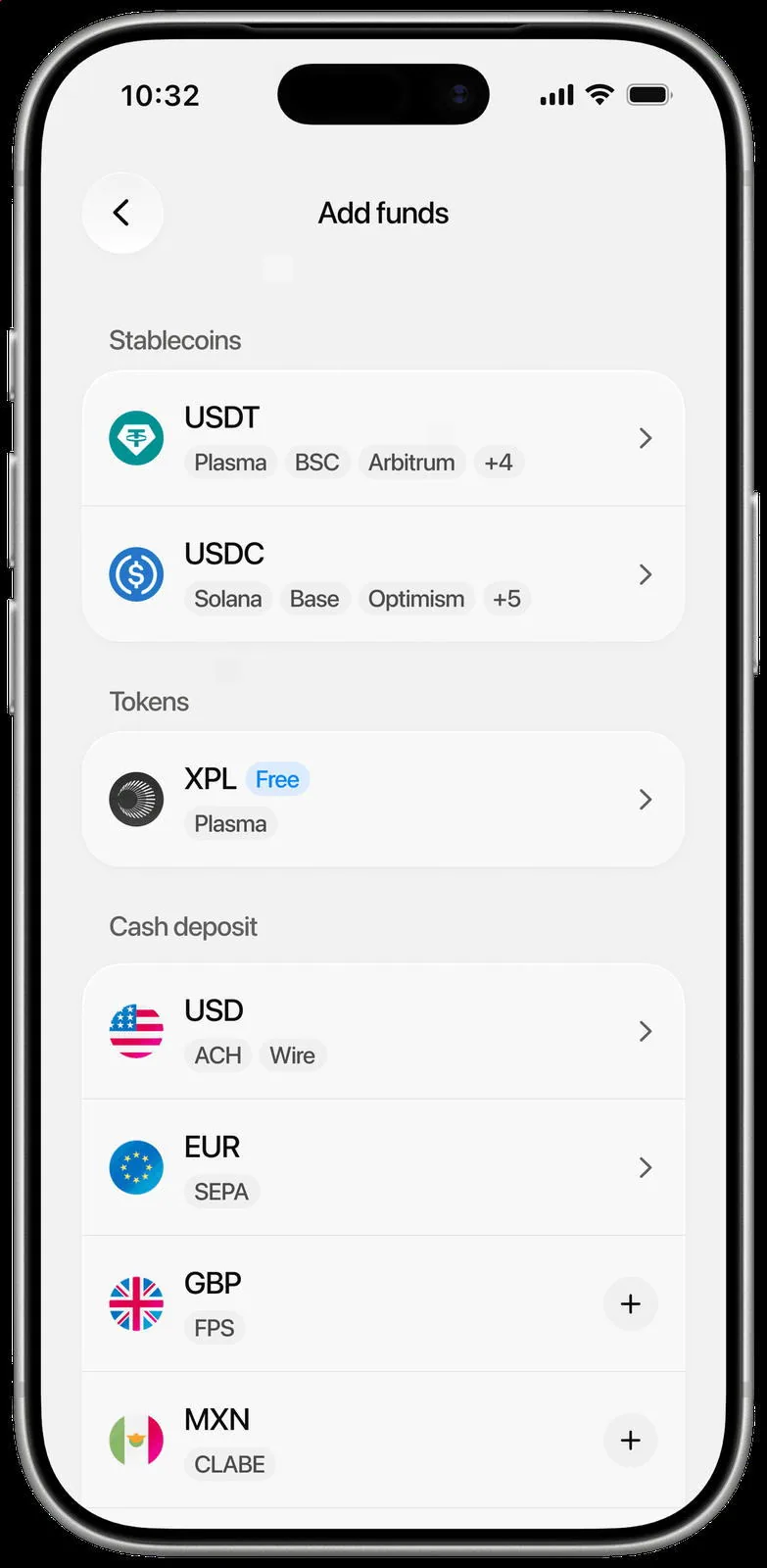
Mainnet beta launched on September 25, 2025, with an initial supply of 10,000,000,000 XPL. That figure describes launch supply, rather than a permanent ceiling or today's circulating amount. The token design includes scheduled unlocks and validator inflation that activates when external validators and stake delegation go live. Base transaction fees burn XPL. Access to delegation depends on the corresponding validator rollout.
Stablecoin bridges connect separate networks
Cross-chain services connect balances across separate ledgers; an ordinary transfer on Plasma changes balances on Plasma. The asset's bridge mechanism determines how value moves between networks. USD₮0 and native USDC use different systems, even though both supply dollar-denominated tokens within the same EVM environment. Their supported connections and fee requirements govern cross-chain access.
USD₮0 uses LayerZero's OFT framework
USD₮0 uses LayerZero's Omnichain Fungible Token (OFT) standard, with its network deployments backed by USD₮ that an Ethereum adapter holds. Messages coordinate movement between those deployments without moving the underlying backing each time. Bridge verification and supported connections govern that interoperability, with distinct token and OFT contracts handling local balances and cross-chain communication.
USDC uses Circle's burn-and-mint protocol
Circle's Cross-Chain Transfer Protocol (CCTP) supports native USDC transfers to and from Plasma. CCTP burns native USDC on the source network and authorizes minting through Circle's attestation process. A destination wallet that signs the mint transaction needs gas for that operation, independently of whether a local payment qualifies for sponsorship.
Lending and swaps add application-specific conditions
Aave V3 provides a supply and borrowing market on Plasma. Suppliers earn interest at rates that change with borrower demand and protocol parameters; eligible collateral supports borrowing under each reserve's risk settings. Withdrawal requires available underlying liquidity, and an active borrower must preserve the required collateralization. Borrow positions can become eligible for liquidation when their health factor falls below 1. Supply and borrow caps can additionally limit access to a reserve.
Uniswap V3 supports swaps and liquidity provision on Plasma through smart-contract pools, whose fees and available liquidity affect execution independently of network gas. Chainlink price feeds also provide external market data for applications on Plasma. Consensus agrees on blockchain state; an oracle supplies information that a financial contract may need about asset prices.
Plasma One connects stablecoin accounts with card spending
Plasma One provides a stablecoin account on the Plasma network with transfers, earning access, and a Visa card. Rain issues the card, while Bridge powers global account services. Card acceptance follows Visa's merchant network; merchants do not need to accept a Plasma token transfer themselves. Local-currency services connect the account with funding and bank withdrawals. Available withdrawal rails and account eligibility vary by region, and partners can charge foreign-exchange or withdrawal fees. Merchant acceptance and permission to open an account are separate conditions. Users custody their underlying stablecoins, while card and local-currency services operate through those payment partners.
Does a Plasma One payment balance earn yield automatically?
Plasma One's Earn yield requires a deposit into an Earn vault. The feature provides access to DeFi lending through third-party vault providers, whose returns vary with market conditions and protocol performance. Depositing into a vault creates exposure to its strategy, and the balance's dollar denomination does not set its interest rate.
Plasma One's stablecoin balances do not carry bank-deposit insurance. Self-custody does not protect funds against vault bugs, protocol failures, or shortages of withdrawal liquidity, so lending introduces dependencies beyond simply holding a payment asset. The underlying contracts and available liquidity govern access to funds, alongside any conditions that the particular vault imposes.
Card cashback rewards qualifying spending. Its payout rules and tier conditions differ from the lending activity that generates yield.
Custom gas, confidential payments, and the Bitcoin proposal
Custom gas and confidential payments affect different payment features. Gas abstraction changes the token that pays fees; privacy features change the information that a transfer exposes.
Custom gas tokens
The network fee roadmap proposes a protocol-maintained paymaster for whitelisted ERC-20 gas tokens. Developers would register supported tokens so users could pay fees with assets that they already hold. This model charges execution costs in another asset; transfer sponsorship covers eligible costs for the user.
Confidential payments
The planned opt-in module uses zero-knowledge proofs and stealth addresses, with selective disclosure for compliance. Ordinary explorers provide access to transaction, address, and token data, so sponsorship alone does not hide a payment. Privacy requires its own implementation, and an application's identity checks serve a different purpose from controlling what the blockchain exposes.
The beta-era Bitcoin proposal
The Bitcoin bridge proposal outlined pBTC backed by Bitcoin, verifier attestations, and multiparty signing. Its design placed this bridge beyond the mainnet beta launch's feature set. That proposal addressed Bitcoin access to smart contracts, with separate verification and withdrawal mechanisms from the supported dollar-stablecoin routes.
Choosing wallet access or a payment account
A direct wallet and a payment account can both hold stablecoins on the same network. Wallet access exposes the underlying contracts; the account adds card and local-currency services. Their shared blockchain does not make withdrawal rails, fee sponsorship, or earning settings identical. Match the access path to the function that you need:
- For a payment without user-paid gas, confirm sponsorship for the supported transfer method.
- For swaps or lending, account for contract gas and the application's own charges.
- For cross-chain movement, match the asset's supported bridge with both networks.
- For card spending or bank withdrawals, account eligibility and partner fees govern the available service.
- For earning, distinguish a spendable wallet balance from funds committed to a lending strategy.
What to know about Plasma.to
-
Which browser wallets support the Plasma network?
- MetaMask, Trust Wallet, and Rabby support connection to Plasma through their EVM network configuration. Mainnet uses chain ID 9745 and XPL as its native currency. A wallet connection establishes network access; support for a particular application, asset display, or sponsored transfer service requires that feature's own integration.
-
Can I add a Plasma One card to Apple Pay or Google Pay?
- Plasma One cards support Apple Pay on iPhone and Google Pay on Android where each platform makes the feature available, and adding a card also depends on having an eligible Plasma One account and card.
-
Does Plasma One require an XPL lock to open an account?
- Plasma One's free Lite tier requires no XPL lock or subscription. Eligible Core accounts have subscription or XPL-lock access paths, while Platinum requires an XPL lock. XPL tier locks last twelve months from deposit, with no early unlock or card-account closure during the lock. Adding XPL for an upgrade restarts the twelve-month lock on the combined balance. A tier-access lock grants product benefits; it does not earn interest or validator rewards, and the locked token's market value can change.
-
Are Plasma One cashback rewards always available as cash?
- Plasma One can pay cashback in XPL or as spending credit. Spending credit only offsets eligible card purchases; it has no cash value and cannot be withdrawn, transferred, or converted. Cashback also requires qualifying transactions and completion of the program's pending period, so an estimated reward is not a settled payout.
-
How does Plasma testnet differ from mainnet?
- Plasma testnet is a separate environment for testing contract deployments and applications. It uses chain ID 9746; mainnet uses 9745. Testnet XPL pays test-environment gas and does not represent a mainnet balance. Third-party faucets supply test tokens under their own eligibility rules and request limits.