 plasma.to
Plasma.to supports EVM contract testing before mainnet deployment
Updated
Plasma.to provides an EVM-compatible testnet for testing Solidity smart contracts before deploying an application to mainnet. Test XPL pays deployment and transaction gas, while standard Ethereum tooling handles compilation and interaction. Third-party faucet rules govern token access, and testnet results apply to the tested code and configuration.
Reth executes contracts and PlasmaBFT finalizes blocks
The testnet combines Reth-based EVM execution with PlasmaBFT consensus, giving contract code and block settlement separate responsibilities within the same network. Reth processes transactions and updates contract state through the Ethereum Virtual Machine (EVM), while PlasmaBFT orders and finalizes blocks. This arrangement lets development tools use familiar contract interfaces while the network agrees on the resulting state. Contract testing examines execution behavior; consensus finality concerns the ledger that records it. The public testnet launched on July 15, 2025, and operates as a separate development environment alongside mainnet.
The RPC connection determines the deployment network
Development tools reach Plasma testnet through a remote procedure call (RPC) endpoint that exposes Ethereum-compatible methods for network and contract interaction. The endpoint determines which blockchain receives a submitted transaction. A wallet's visible network selection does not automatically change a separately configured deployment script, so both need the intended network configuration. Plasma testnet uses chain ID 9746 and mainnet uses chain ID 9745, so checking the endpoint's reported chain ID distinguishes them before signing. A familiar account address or XPL symbol alone cannot distinguish separate network balances.
Keep mainnet and testnet configuration entries separate. Public endpoints impose rate limits, so automated integration runs need an RPC service that supports their request volume.
How do faucets fund Plasma testnet deployments?
Third-party faucets distribute free test XPL that pays network gas for contract creation and subsequent state-changing test transactions. OpenFaucet and Quicknode offer access to these tokens, with the balance belonging to the requested testnet address. Funding another address does not fund the signer that your script uses. Test XPL supplies the gas resource for execution; a faucet does not deploy or initialize your application.
Plasma testnet faucets follow dispensing rules that their third-party operators set. Eligibility checks, claim intervals, and available funds can differ between services, so a free allocation does not establish unlimited capacity for repeated deployments. The account needs enough test XPL for the estimated transaction cost.
Local tests isolate logic while testnet exercises integrations
Local development networks make contract logic easier to test repeatedly, while public testnet deployments include the network connections that an application uses. Hardhat and Foundry belong to the supported Solidity tooling stack, and local tests can set initial state and compare actual behavior with assertions. They suit rapid investigation of a changed function or an expected rejection. Public testnet then adds interactions with remote nodes, deployed contract instances, and the application's wallet connection. These environments answer different questions within development; neither replaces the other.
A local substitute for another contract only exercises the behavior that the substitute implements. Integration testing with the actual testnet dependency can expose a different interface or permission requirement. Stablecoin transfer applications may depend on token allowances and other deployed contracts. The test must cover those relationships when the application uses them, without assuming that every production dependency has a testnet counterpart.
Each code change needs matching build artifacts
A Solidity build supplies executable bytecode and an application binary interface (ABI), which tells software how to encode calls and interpret responses. The deployment script uses the bytecode, while application code uses the ABI and a contract address. Changing a function signature can therefore require corresponding changes in the application that calls it.
Compiler versions, optimizer settings, and imported libraries can affect the build output. Retaining those settings with the source helps reproduce the compiled build. A filename alone does not identify the exact contract build. Optimizer settings can trade deployment work against the work that later function calls perform. A configuration that reduces runtime work can increase deployment size or cost. Comparing gas across builds therefore requires keeping the optimizer configuration alongside each result. Function names alone do not show whether the compiled execution path changed.
Behavioral tests connect the build to the application's intended rules. Assertions can examine returned values, persistent storage, and emitted events when those form part of the contract's behavior. After a change, rerunning affected tests identifies whether the new logic preserves the behavior that they cover.
Where a contract restricts an operation, tests should cover permitted callers and callers outside that permission. A test for an intended rejection passes when the contract rejects the action for the intended reason. An unrelated connection or configuration error cannot establish that the authorization rule works.
Previously deployed bytecode does not change when someone edits its source file. A new deployment, or an applicable contract upgrade mechanism, must make the revised logic available onchain; any upgrade path depends on the contract's actual design. Repeated test runs need to identify the implementation that they exercise.
The deployment key remains separate from faucet funding
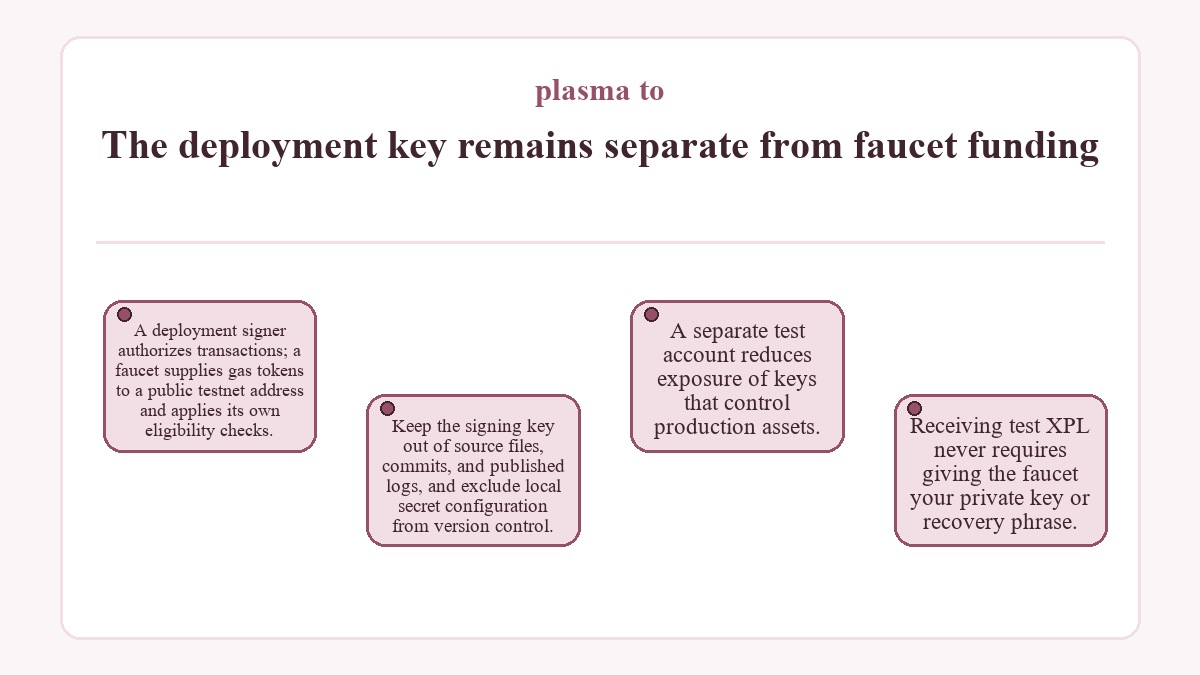
A deployment signer authorizes transactions; a faucet supplies gas tokens to a public testnet address and applies its own eligibility checks. Keep the signing key out of source files, commits, and published logs, and exclude local secret configuration from version control. A separate test account reduces exposure of keys that control production assets. Receiving test XPL never requires giving the faucet your private key or recovery phrase.
Receipts and contract state show different outcomes
A deployment receipt records execution on the selected network, while application assertions establish whether the deployed contract satisfies its intended behavior. A returned transaction hash identifies the submitted transaction; it does not establish successful contract creation. The receipt records block inclusion and execution status, and a successful creation transaction also supplies a contract address. Checking deployed bytecode answers whether that address contains code on the selected chain.
For contract interactions, receipt success means that execution finished without a transaction-level failure. Internal calls can have failures that the surrounding contract handles, so application outcomes still need their own assertions. The expected stored value or other application state provides a different check from an event alone. Logs help integrations track activity, but they cannot independently establish every condition that the application requires.
Do testnet gas measurements predict mainnet fees?
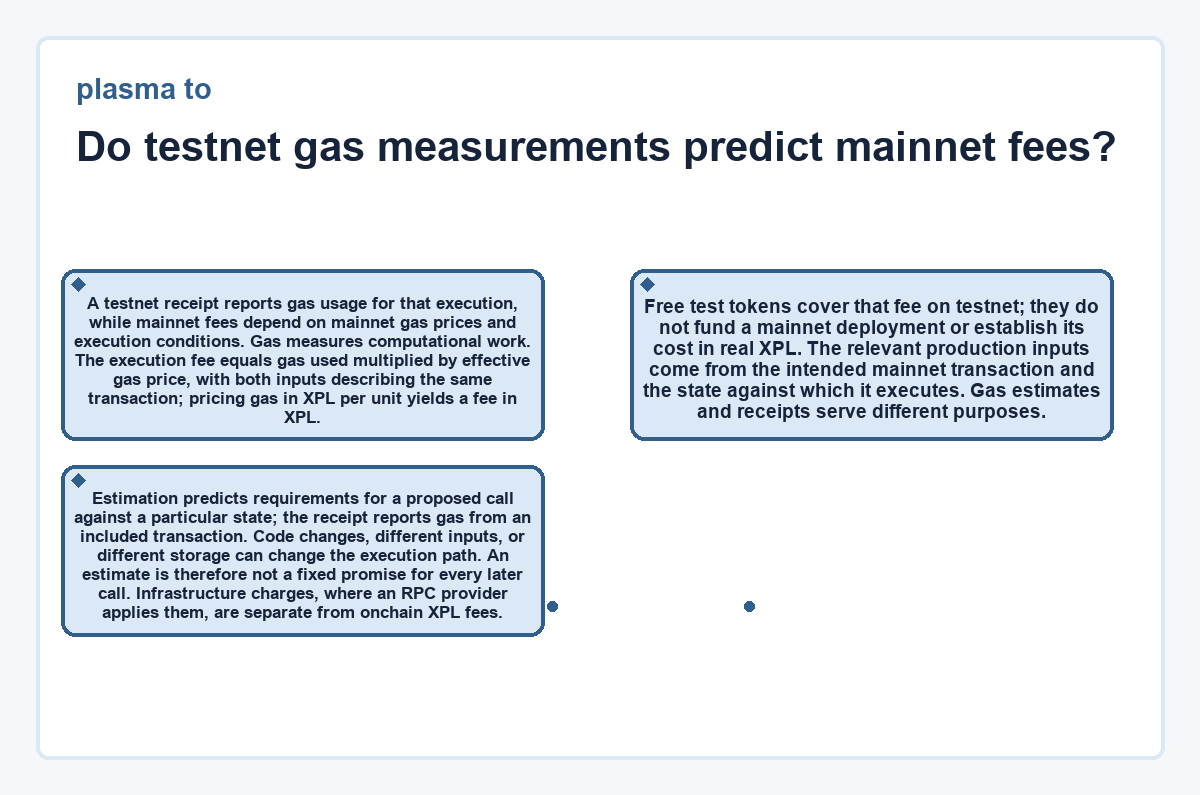
A testnet receipt reports gas usage for that execution, while mainnet fees depend on mainnet gas prices and execution conditions. Gas measures computational work. The execution fee equals gas used multiplied by effective gas price, with both inputs describing the same transaction; pricing gas in XPL per unit yields a fee in XPL. Free test tokens cover that fee on testnet; they do not fund a mainnet deployment or establish its cost in real XPL. The relevant production inputs come from the intended mainnet transaction and the state against which it executes.
Gas estimates and receipts serve different purposes. Estimation predicts requirements for a proposed call against a particular state; the receipt reports gas from an included transaction. Code changes, different inputs, or different storage can change the execution path. An estimate is therefore not a fixed promise for every later call. Infrastructure charges, where an RPC provider applies them, are separate from onchain XPL fees.
Mainnet readiness depends on the release configuration
A mainnet release needs configuration that identifies the intended deployment network, production contract instances, and any dependencies that the application uses. Testnet balances and contract state remain in the testing environment. EVM compatibility permits code reuse across deployments. The surrounding addresses, permissions, and funding still belong to their respective networks.
- If the source or imported dependencies changed, rebuild and rerun the affected behavioral tests.
- If the application calls external contracts, use addresses and permissions that exist on the intended network.
- If an operation requires privileged access, confirm that the production signer or account holds the required permission.
- If the interface changed, match its ABI and contract address to the intended deployed build.
- If deployment targets mainnet, fund the signer with mainnet XPL and select the mainnet network.
The application's connection must identify the same network as its deployment; otherwise, correct contract code can remain disconnected from the intended interface. Plasma mainnet uses chain ID 9745.
Plasma.to: quick answers
-
Can Plasma testnet run Vyper contracts?
- Plasma supports Vyper contracts through its EVM-compatible execution environment. Language support still requires a compatible compiled build and correctly configured deployment tooling. Any external contracts that the application uses need their own network-specific configuration and tests. A compiler or deployment configuration error can occur independently of language compatibility.
-
Does reading a testnet contract require XPL?
- An ordinary offchain read through a node does not spend test XPL on network gas. It queries or simulates execution without publishing a state change. A read performed inside a submitted transaction contributes to that transaction's gas usage. RPC providers can apply separate access restrictions or usage charges.
-
Why is a deployed testnet contract missing from the explorer?
- Explorer indexing can lag behind a confirmed testnet deployment. A mainnet explorer also cannot display a deployment that only exists on testnet. A receipt and bytecode at the contract address provide more direct deployment evidence than an absent explorer search result while indexing catches up.
-
Do Plasma testnet faucets require a mainnet token balance?
- A mainnet balance requirement belongs to the faucet operator, so it varies between services. Quicknode's free base claim does not require a minimum mainnet balance. Other operators can impose balance or account checks. These restrictions determine eligibility for that faucet; they are not network requirements for deploying a contract.
-
Are private Solidity variables hidden on Plasma testnet?
- Solidity private variables remain observable through public blockchain data. The visibility modifier limits access from Solidity code; it does not encrypt storage. Test data, transaction inputs, and event contents therefore need the same confidentiality treatment as other publicly accessible information.
-
Can a failed testnet transaction still use XPL?
- A transaction that the chain includes can consume test XPL even if contract execution reverts. Gas pays for computation that the EVM already performed. A local simulation error or a failure before submission does not itself create an onchain fee. The included transaction's receipt identifies execution status and actual gas usage.
-
Which time unit should Plasma contract tests use for block timestamps?
- Tests using Solidity block.timestamp should calculate time in seconds. Plasma preserves second-based block timestamps. Convert any millisecond duration before combining it with that value. Comparing timestamps and durations that use different units produces incorrect timing conditions, even when the contract compiles successfully.
-
Is source verification enough to approve a Plasma testnet contract for mainnet?
- Source verification establishes correspondence between published source code and deployed bytecode. It does not certify the contract's business logic or security. Mainnet preparation also needs tests for intended behavior and assessment of actual permissions and dependencies. A verified source listing can still describe vulnerable code.