 plasma.to
Plasma.to stablecoin transfers - confirmation at the destination
Updated
Plasma.to stablecoin transfers complete when the intended recipient receives the correct stablecoin on the selected destination network. A successful source bridge transaction records only the departure side of a cross-chain transfer. Match the destination execution record with the recipient address, token contract, and credited amount. A wallet balance can lag behind the ledger, while a bridge message can await verification or execution. Those different states determine whether to refresh the display, wait, or recover the existing transfer without submitting another source payment.
Key takeaway: A successful source transaction leaves a cross-chain transfer unfinished until destination execution credits the intended token to the correct recipient.
USD₮0 and USDC transfer paths
The selected token and transfer path determine which contracts connect the source and destination networks and authorize destination delivery. USD₮0 uses LayerZero's Omnichain Fungible Token (OFT) framework, with messaging contracts that connect compatible deployments and verifier networks that validate cross-chain messages before destination execution. Between USD₮0 OFT deployments, the source contract burns tokens, and verified messaging enables minting at the destination. Routes involving original USD₮ on Ethereum use an adapter that locks or unlocks that asset. Legacy Mesh connections use liquidity contracts for existing USD₮ deployments. Their output asset and charges follow the selected connection, so a single burn-and-mint description cannot cover every path.
Native USDC follows Circle's Cross-Chain Transfer Protocol (CCTP). A source burn produces a message, Circle signs an attestation after the required confirmation level, and destination execution mints USDC. Native USDC, EURC, and CCTP support launched on Plasma in August 2026. Protocol support and an application's available routes remain separate requirements.
The USD₮0 interface can also offer Aori on supported routes. A solver deposits the authorized source tokens into the protocol contract and delivers the specified output to the destination recipient. Settlement then lets the solver claim the source funds. The destination fill is the recipient's delivery event, even if the solver's settlement remains unfinished.
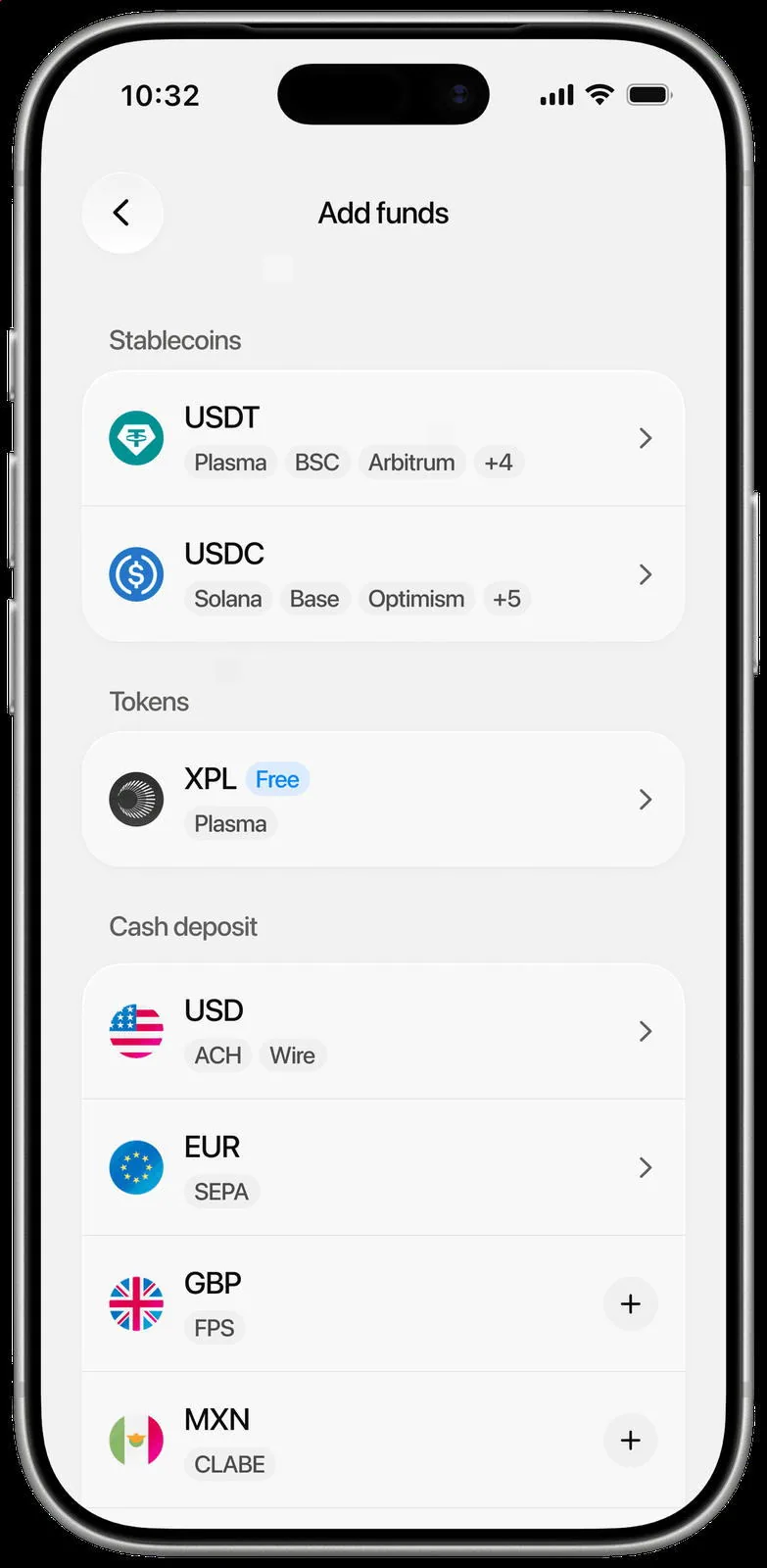
Does source confirmation prove the funds arrived?
A successful source transaction does not prove arrival when the transfer crosses networks. On a direct transfer within Plasma, the token movement and recipient balance update occur on that chain, while a bridge also needs its destination-side action to finish. An approval receipt confirms spending permission, while a transfer or burn receipt records a different operation. Identifying which transaction succeeded prevents a green status from answering the wrong question.
Destination proof ties the credited token to the requested network, recipient, and transfer. Examine the transaction's token movements and the emitting token contract. The transaction's main destination address may be a bridge or token contract, so it does not necessarily identify the final token recipient. A balance query shows the account's current holding, which subsequent incoming or outgoing transactions can change; the matching transfer record preserves evidence of the original credit.
Recipient compatibility before submission
Before committing funds, establish the exact stablecoin and destination network that the receiving account accepts. A compatible address format does not prove deposit support, so the bridge destination must match the recipient's deposit instructions. The source transaction must use the route's source network. For a service's deposit address, follow its token requirements and any required deposit reference. The route quote identifies the input token and expected output. Confirm that the source balance is spendable, current transfer limits permit the requested amount, and necessary gas is available. Mainnet and testnet balances belong to separate environments, so a successful contract test cannot fund a mainnet recipient, even when the addresses look identical.
Approvals and transfer authorizations
An approval lets a specified spender use the token allowance; it does not itself deliver stablecoins. USD₮0 on Plasma supports EIP-3009 authorizations that a relayer can submit, so a signature can grant transfer permission before an onchain transaction exists. Review the authorized recipient, amount, validity window, and verifying contract before signing. Reject an unexplained spender or recipient change. The wallet or service submits the source transaction, whose receipt records execution success or failure. Closing the browser does not withdraw a signature or erase a confirmed transfer.
Gas sponsorship and the quoted recipient amount
Ordinary transactions on Plasma use XPL for network gas, while supported sponsored USD₮ transfers can avoid a user-paid gas charge. Sponsorship belongs to the integrated transfer path and its eligibility controls; it does not establish free bridging, free swaps, or free destination execution through another provider. Source gas, messaging costs, protocol charges, and application fees can apply independently.
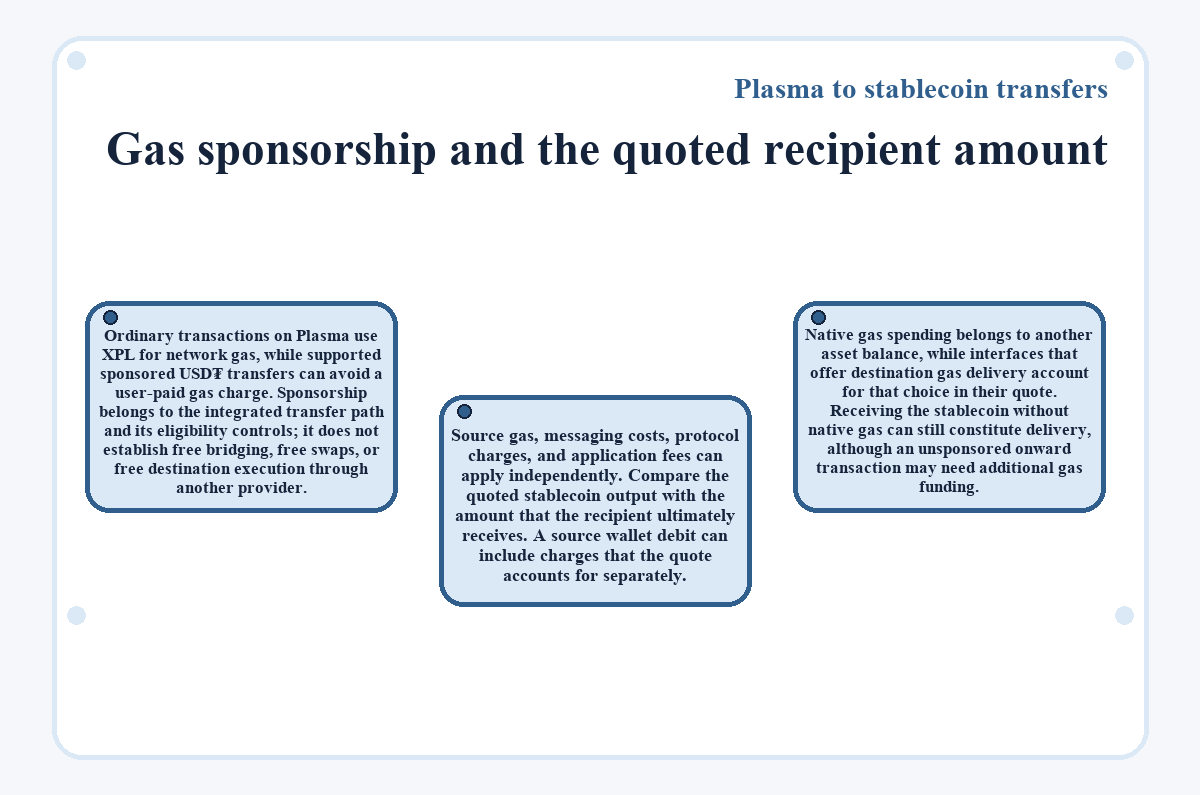
Compare the quoted stablecoin output with the amount that the recipient ultimately receives. A source wallet debit can include charges that the quote accounts for separately. Native gas spending belongs to another asset balance, while interfaces that offer destination gas delivery account for that choice in their quote. Receiving the stablecoin without native gas can still constitute delivery, although an unsponsored onward transaction may need additional gas funding.
How long should a cross-chain transfer stay pending?
The selected route's estimate gives the expected wait, and its recorded progress explains a delay. On messaging routes, source finality, verifier work, and destination execution can finish at different times, so a fast block on Plasma does not establish an end-to-end bridge deadline. Track those stages against the estimate. An intent-based route also needs its solver to fulfill the order; the recipient's funds can arrive before later solver settlement finishes. A pending source transaction on an Ethereum Virtual Machine (EVM) network has no mined receipt. A failed source receipt identifies an execution problem that a destination retry cannot repair.
For CCTP V2 Standard Transfer with Plasma as the source, the listed average attestation time is approximately one second. The associated requirement is three source block confirmations. This estimate covers attestation availability, not arrival in another wallet. When another network supplies the source, its finality rules determine the attestation wait.
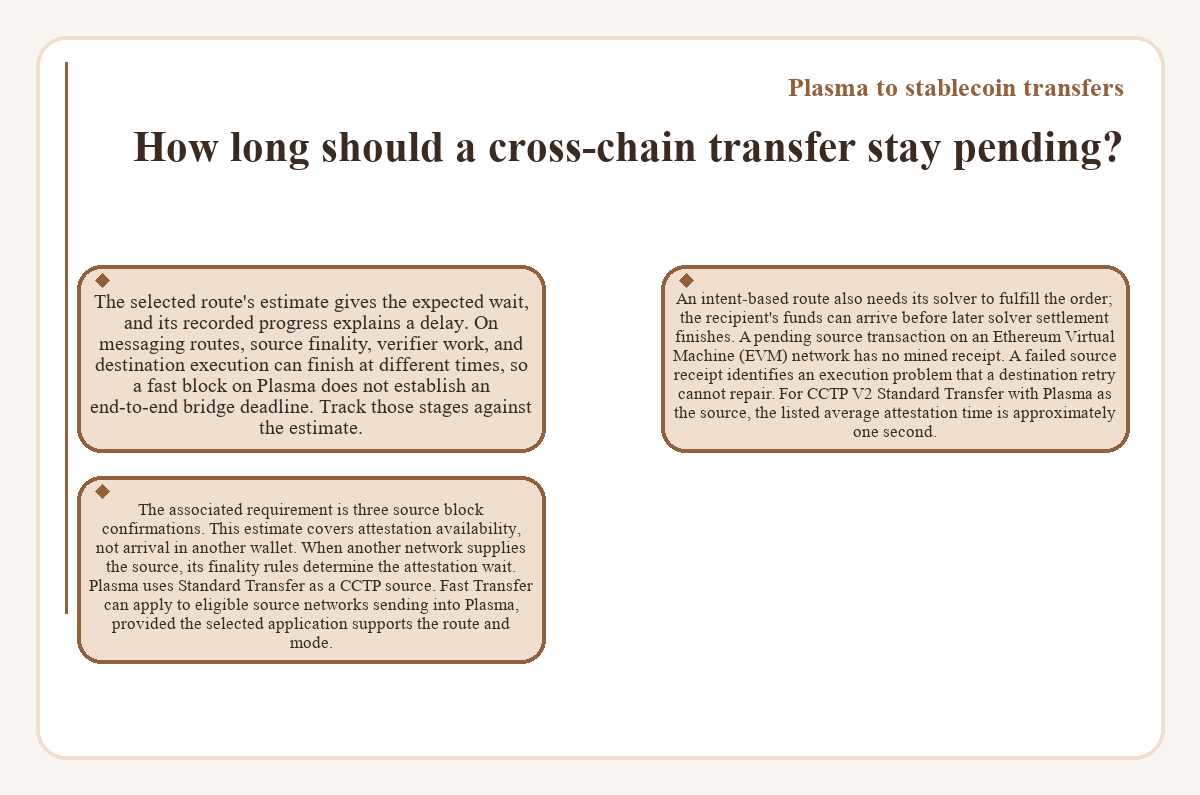
Plasma uses Standard Transfer as a CCTP source. Fast Transfer can apply to eligible source networks sending into Plasma, provided the selected application supports the route and mode.
An unchanged wallet balance after source confirmation
Consider a hypothetical transfer through a supported OFT route to Plasma, with the chosen token, amount, recipient, and route settings fixed for this case. After source confirmation, the wallet still shows its earlier balance. The expected outcome is a matching destination credit to that recipient.
First read the destination token balance and the existing message's progress without signing another transaction. These checks leave the transfer unchanged. On the normal path, destination execution has succeeded, and the token contract reports the matching credit; refreshing the wallet or adding the correct token reveals the received balance without repeating the transfer.
On the edge path, verification has finished, but destination execution has failed because its gas allowance was insufficient. A supported retry targets that same message on the destination chain with enough execution gas. It can complete delivery without a second source stablecoin debit. The retry still needs someone to pay its destination transaction cost.
An unverified message remains a waiting case, because destination retry cannot replace missing verification. A route configuration error may require the application's operator to correct it. Stop sending additional source transfers while that issue remains unresolved, and retain the original transaction record.
Verified messages and delivered tokens
LayerZero's Verified state means configured verification has finished; Delivered means destination execution succeeded. CCTP attestation authorizes destination processing, while minting issues the token. A quote expresses expected output before execution. Aori's destination fill and the solver's later settlement describe different events. An unfilled Aori order follows its supported cancellation procedure and expiry conditions. Those procedures do not reverse a completed recipient payment. The destination token contract and recipient identify which account actually received funds.
The boundaries of transfer recovery
Once a finalized transfer reaches the wrong recipient, a bridge retry cannot redirect that completed credit. A return requires a separate authorized transfer, if the recipient account or receiving service can provide one. Do not assume the provider can reverse the ledger.
A failed transfer does not automatically remove an earlier token allowance. Reducing or revoking that allowance restricts future spending by its specified spender. It cannot refund a completed burn or recover tokens that already reached another address.
A receiving service can apply deposit rules beyond blockchain settlement. A successful token transfer therefore does not prove that the service has credited a usable account balance. Its supported network and asset requirements still apply.
Transaction hashes and recipient addresses can reveal ordinary transfer activity on a public ledger. Share the records needed to identify a delayed transfer without exposing private keys or recovery phrases. Status investigation does not require control of the signing account.
An onward payment, swap, or lending deposit starts another operation after arrival. Its fees, permissions, and application requirements can differ from the transfer that delivered the funds. If the destination service does not accept that token deployment, stop before submission; a completed transfer cannot establish the service's compatibility.
Common questions about Plasma.to stablecoin transfers
-
Can the bridge recipient differ from the connected source wallet?
- The USD₮0 transfer interface supports a destination address that differs from the connected source wallet. The selected interface and route must support the recipient type, and the receiving account must accept the destination network and token. Review the actual destination address before authorizing the transfer. Connecting a wallet identifies the source account; it does not by itself establish the intended recipient.
-
Does native EURC on Plasma use the same CCTP transfer path as USDC?
- Native EURC availability on Plasma does not establish a CCTP route for EURC. CCTP's listed token support on Plasma concerns USDC. An interface that offers USDC bridging therefore does not demonstrate EURC bridging support. An EURC transfer needs a route that explicitly supports that asset and its destination deployment; a same-chain token transfer follows different requirements.
-
Why does a stablecoin transaction show zero native value?
- A token transfer can show zero native value because its stablecoin amount belongs to the token contract call. The transaction's native-value field measures the native asset that the call sends. Read the token transfer record for the stablecoin amount and recipient, and match its emitting contract. A zero native-value field does not by itself indicate that the stablecoin transfer failed.
-
Is Circle's Forwarding Service available for CCTP transfers into Plasma?
- Circle's listed Forwarding Service destinations do not include Plasma. CCTP destination support still permits USDC transfers into Plasma, but the destination mint needs an application, relayer, or permitted manual submission. Confirm which party submits that action and pays its gas before committing the source burn. Protocol availability alone does not promise automatic delivery through every interface.
-
Do I need to pay network gas just to inspect a recipient's token balance?
- Reading a token balance through a wallet, explorer, or ordinary read-only contract query does not require an onchain transaction or network gas. RPC access can have separate service limits or charges. A request to approve token spending is a different action. Viewing status should not require a transfer authorization, a private key, or a recovery phrase.
-
How do I read USD₮0 transfer amounts that an explorer shows in raw units?
- USD₮0 uses six decimal places, so divide a raw token amount by 1,000,000 to obtain the token quantity. An explorer may already perform that conversion. Check its unit label before comparing the received amount with your quote. A fiat-value display uses a price estimate and can change even when the underlying token quantity stays constant.